Confusion in the Strait!

Until a few months ago, none of us had ever heard of the Strait of Hormuz — but now we are all experts, with nightly reports showing the narrow passage where ships carrying oil can be blocked or fired upon. I have created a graphic showing the geographic details of the Strait below (Figure 1).
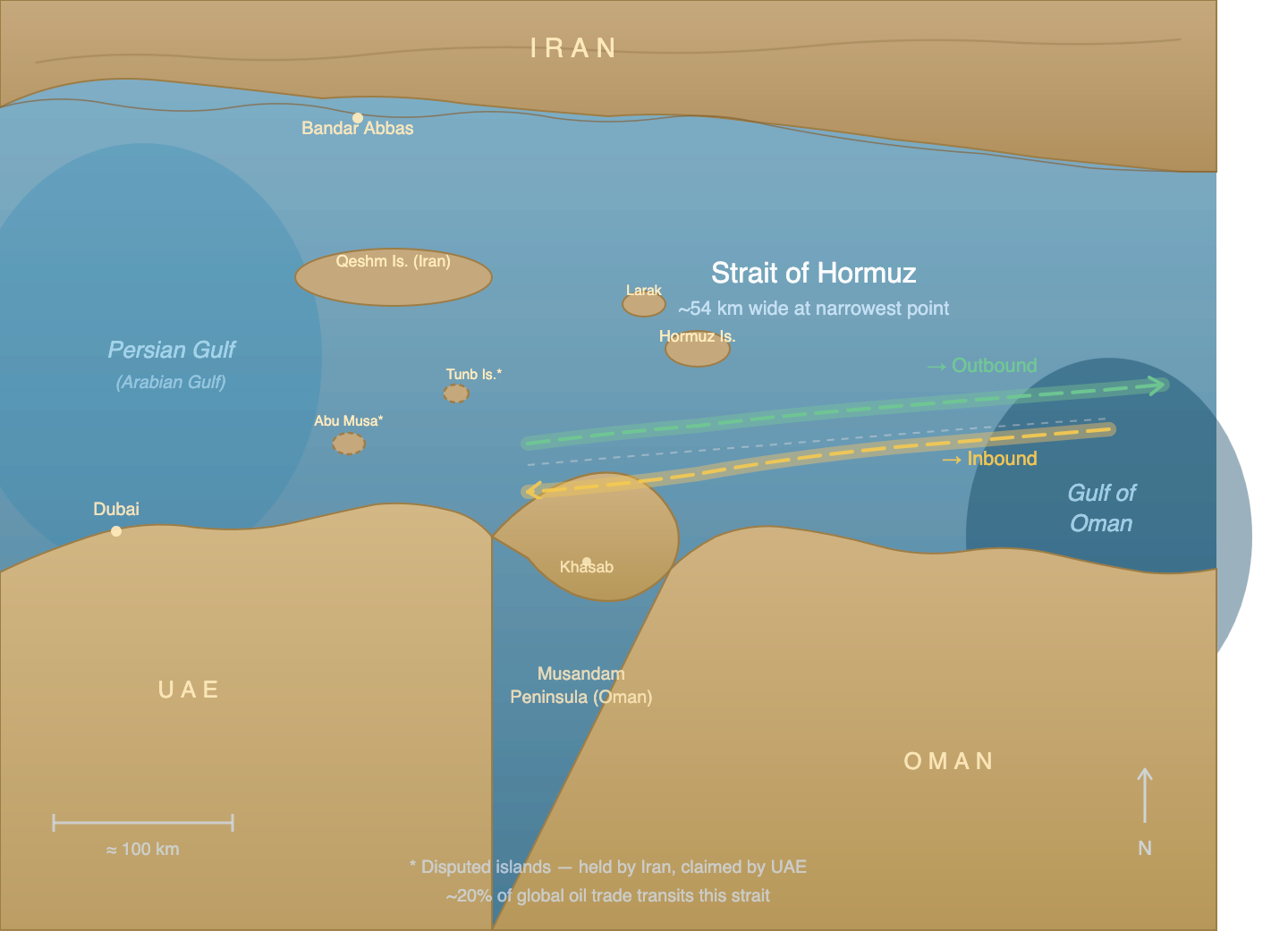
Figure 1. Graphic outlining the geographic details of the Strait of Hormuz. The Strait of Hormuz. Iran lies to the north; the Musandam Peninsula of Oman juts dramatically into the strait from the south, creating the bottleneck. The UAE sits to the southwest. The two shipping lanes run through the narrowest section — each only about 3 km wide — separated by a buffer zone. Yellow arrows show inbound traffic (laden tankers heading into the Gulf of Oman); green shows outbound (returning empty tankers and other vessels). Qeshm, Hormuz, and Larak islands are Iranian-held. Abu Musa and the Tunb Islands are disputed — seized by Iran in 1971 and still held, though the UAE claims sovereignty. These islands give Iran significant tactical leverage over the lanes. Bandar Abbas is Iran’s main naval base on the strait; Khasab, on the Musandam Peninsula, is the Omani military port.
Insurance challenges have made the owners of oil tankers reluctant to attempt the passage, for fear their valuable cargoes end up at the bottom of the ocean. While U.S. military planners are reported to have considered the threat of closure of the Strait by Iran prior to the war, a proactive strategy to keep it open does not appear to have been part of the initial military planning.
Now the U.S. military operation has reached the 60-day limit under the War Powers Act, after which the President must seek congressional authorisation to continue. An argument has recently been advanced that the ceasefire agreed by President Trump effectively resets the 60-day clock, entitling him to a further 60 days before congressional approval is required. One wonders how many such resets can be claimed before the courts intervene?
As I contemplate the logistics of maintaining this enormous U.S. force in the Gulf, the mind boggles — at the challenge of supplying troops with food alone, let alone military equipment. I have been doing some further investigations to understand how many military personnel and materiel are now in the Middle East. It is staggering and one wonders how long such a long force can be maintained there.
U.S. Military Forces in the Middle East — May 2026
Background
The current buildup is part of Operation Epic Fury, the U.S. military campaign against Iran that began with joint U.S.-Israeli strikes on 28 February 2026. For the first time in more than two decades, three aircraft carriers — along with hundreds of Navy aircraft and thousands of sailors and Marines — are deployed to the Middle East. The last time the U.S. had three carriers in the area was during Operation Iraqi Freedom in 2003.
The Three Carrier Strike Groups (CSGs)
A standard carrier strike group is composed of roughly 7,500 personnel — usually an aircraft carrier, at least one cruiser, a destroyer squadron of at least two destroyers or frigates, a carrier air wing of 65–70 aircraft, and sometimes submarines and supply ships. Three CSGs therefore represent approximately 22,500 naval personnel at sea, plus their air wings and escorts.
(Just for contrast, the UK decided to send a naval destroyer — HMS Dragon — to Cyprus after it was attacked by a drone strike, and it took three weeks for the ship to arrive due to a combination of maintenance work, re-fitting, and a remarkable revelation that the private contractor responsible for preparing Royal Navy ships at Portsmouth was effectively working office hours under a cost-cutting government contract. The British Navy is at its lowest number of ships and personnel since the end of the Cold War — down from 50 destroyers and frigates in 1991 to just 13 today. No wonder Trump criticised the UK, dismissing their aircraft carriers — which have significantly reduced capability compared to their American equivalents — as ‘toys.’)
USS Abraham Lincoln — operating in the Arabian Sea since January 2026, conducting nonstop combat operations. The Lincoln strike group is accompanied by at least eight Arleigh Burke-class guided-missile destroyers distributed across the Arabian Sea, Eastern Mediterranean, and Red Sea.
USS Gerald R. Ford — the Navy’s newest and most capable supercarrier, operating in the Red Sea. The Ford-class carrier introduces a great advance in operational capability with its Electromagnetic Aircraft Launch System and Advanced Arresting Gear, enabling significantly higher sortie generation rates than older carriers.
USS George H.W. Bush — the third and most recent arrival. Bush entered the region via the Indian Ocean on 23 April 2026, having taken the longer route around the Cape of Good Hope to reduce exposure to threats in the Red Sea and Bab el-Mandeb Strait. The Bush strike group includes the guided-missile destroyers USS Ross, USS Donald Cook, and USS Mason, along with the fast combat support ship USNS Arctic.
Total naval vessels: U.S. naval presence in the region now exceeds 30 warships, according to CENTCOM. Additional assets include three Littoral Combat Ships (USS Canberra, USS Tulsa, USS Santa Barbara) based in Bahrain with mine-countermeasure equipment, plus Avenger-class minesweepers deployed to the Strait of Hormuz area.
Aircraft: Combined, the three carriers embark 27 squadrons of more than 200 aircraft. The nine guided-missile destroyers across the three groups are equipped with 846 vertical launch system (VLS) tubes loaded with offensive and defensive missiles. At least three fast-attack submarines provide additional undersea capability.
Two Amphibious Ready Groups (Marines)
In addition to the carrier groups, two Amphibious Ready Groups with Marine Expeditionary Units embarked have been sent to the Middle East as part of Operation Epic Fury. Each ARG typically carries around 2,200 Marines and consists of an amphibious assault ship plus support vessels.
Land-Based Forces at Regional Bases
The U.S. military has between 40,000 and 50,000 service members at bases and installations across the Middle East. The key ones are:
Kuwait (largest ground presence): An estimated 13,500 personnel, including Ali Al-Salem Air Base and Camps Arifjan and Buehring. Kuwait serves as the primary logistics and Army headquarters hub.
Qatar — Al Udeid Air Base (largest single U.S. base in the region): Approximately 10,000 military personnel as of 2026, housing the forward headquarters of U.S. Central Command and U.S. Air Forces Central Command. Iran attacked the base on 28 February 2026 during the opening of the conflict.
Bahrain — Naval Support Activity: More than 8,300 service members and their families, where U.S. Naval Forces Central Command (Fifth Fleet) is headquartered. Bahrain also hosts the Combined Maritime Forces coalition of 47 nations.
Jordan: Nearly 4,000 military personnel, with dozens of attack aircraft at Muwaffaq Salti Air Base.
UAE — Al Dhafra Air Base: Hosts advanced aircraft including F-22 Raptors and surveillance/AWACS platforms.
Iraq and Syria: Around 2,500 troops in Iraq and 900 in Syria for counter-terrorism operations.
Saudi Arabia — Prince Sultan Air Base: Reactivated to support air and missile defence operations.
The Overall Picture
The arrival of USS George H.W. Bush in late April coincides with a broader U.S. military surge bringing total personnel in the region above 60,000 — across approximately 19 installations. To summarise the extraordinary scale of resources committed:
3 carrier strike groups → ~22,500 sailors at sea
2 amphibious ready groups → ~4,400+ Marines afloat
30+ warships in the CENTCOM area, plus submarines
200+ carrier aircraft at sea
40,000–50,000 land-based troops across regional bases
Total in Gulf: over 60,000 U.S. military personnel
Estimated Costs to Date
The first six days of combat cost $11.3 billion — roughly $1.88 billion per day, or $21,800 per second. Each carrier strike group costs ~$6.5 million per day to operate. Tomahawk cruise missiles cost around $2 million each, and hundreds were fired. SM-3 interceptors — used to shoot down Iranian ballistic missiles — cost $36 million apiece.
The Pentagon’s current budget request includes more than $70 billion for missile procurement and related systems — nearly three times the previous year’s figure — as replenishing depleted interceptor stockpiles is expected to take years even at accelerated production rates. It is not inconceivable that before this conflict is resolved, total costs could approach $1 trillion.
Trump’s Shifting Positions: A Chronology
Apart from the staggering costs, the shifting strategy — or simply the shifting thinking — of President Trump can make your head swim. At a local ANZAC DAY remembrance in our area, I talked to a senior Australian naval officer. He outlined how difficult and confusing Trump’s approach is for allied military personnel.
It is difficult to determine whether he is operating on instinct or following a coherent plan. The latter may be the case, but as I outlined in my previous newsletter on The Art of the Deal, Trump does not give away his reasoning.
What I have attempted below is to chart, with dates, what President Trump has actually said over the past two months — statements that have certainly confused me, and hopefully the Iranians too!
Phase One: Rapid Victory Declared (28 February – 7 March)
28 February: Trump gives the order to proceed with Operation Epic Fury. U.S. warships launch Tomahawk missiles while B-2 stealth bombers, B-1 Lancers, and B-52s strike fortified ballistic missile facilities inside Iran.
1 March: Trump says “combat operations continue at this time in full force, and they will continue until all of our objectives are achieved.” When asked how long the strikes would last, he says: “We intend four to five weeks.”
2 March: Trump says “We’re already substantially ahead of our time projections,” repeating the “four to five weeks” estimate and adding “we have capability to go far longer than that.” He is also reported to have said: “We will win easily.”
3 March: “We won the war.”
7 March: “We defeated Iran.”
Phase Two: The Strait Proves a Challenge (8 March – 1 April)
6 March: Trump declares that only Iran’s “unconditional surrender” would be acceptable and threatens to attack Iranian energy infrastructure and bridges if a deal is not reached.
14 March: “We need help to open the strait.” — a significant admission that the Strait of Hormuz, Iran’s primary remaining source of leverage, has not been secured.
15 March: “If you don’t help me, I’ll remember it” — directed at allies who had not joined the operation.
16 March: “We don’t really need any help — I was checking loyalty.”
20 March: “NATO is cowardly.”
22 March: “Last warning. Iran is finished.” Trump sets a deadline of 23 March for a deal, later extended to 7 April.
23 March: Trump says the U.S. has been speaking to “a top person” in Iran: “They called, I didn’t call. They want to make a deal, and we are very willing to make a deal.” The IRGC-affiliated Fars News denied any negotiations had taken place.
25 March: “We are negotiating with Iran.” Pakistani officials deliver a 15-point U.S. ceasefire proposal to Tehran.
27 March: “The Ayatollah and I will jointly manage the Strait of Hormuz” — a striking reversal from the demand for “unconditional surrender” three weeks earlier.
31 March: On the nuclear sites bombed by B-2s, Trump tells Fox News: “I don’t care about the nuclear material in Iran. We’ll watch it via satellite” — adding that the deeply buried material is “pretty safe.” This directly contradicted the war’s stated primary objective of eliminating Iran’s nuclear capability.
Phase Three: Ceasefire and Contradiction (7 April – present)
7 April: Trump warns: “A whole civilization will die tonight, never to be brought back” if Iran does not reach an agreement. Hours later, a ceasefire is announced.
8 April: Trump says the U.S. will work with Iran to “dig up and remove all of the deeply buried Nuclear ‘Dust’” — directly contradicting his 31 March statement that the material was “pretty safe” and he didn’t care about it. On the same day, Vice President JD Vance calls the ceasefire a “fragile truce.”
11 April: U.S. and Iranian officials meet for face-to-face talks in Islamabad, lasting 21 hours.
12 April: Vance announces the sides have “not reached an agreement,” largely because of Iran’s refusal to abandon its nuclear programme.
13 April: The U.S. implements a blockade of Iranian ports. Trump warns that if a deal is not reached, “it won’t be pleasant” for Iran.
17 April: After Iran offers to reopen the Strait in exchange for a ceasefire with Lebanon, Trump says the U.S. port blockade will continue until a comprehensive final deal is agreed.
18 April: Iran shuts the Strait again, blaming U.S. “breaches of trust.” Trump says negotiations are ongoing but Iran “got a little cute.”
19 April: “We’re offering a very fair and reasonable deal, and I hope they take it because, if they don’t, the United States is going to knock out every single power plant, and every single bridge, in Iran.”
20 April: Trump says it is “highly unlikely” he will extend the ceasefire, which he says expires in two days.
21 April: Trump says he expects to resume bombing if no deal is reached the next day — then, that same afternoon, reverses course and extends the ceasefire indefinitely pending an Iranian proposal. When asked five separate times whether he would extend the ceasefire, Trump gave three different answers: “If there’s no deal, fighting resumes”; “If we need to, I would do that”; and “We’ll see. I don’t know that we’ll have to.”
Late April: Trump tells Bloomberg that Iran has agreed to an “unlimited” suspension of its nuclear programme; he says that Tehran “agreed to everything”; and also says that a deal will come “in the next day or two.” Iranian negotiators dispute each claim.
1 May: Trump sends a war powers letter to Congress stating: “The hostilities that began on February 28, 2026, have terminated” — even as the blockade of Iranian ports continues and the Strait of Hormuz remains closed.
I am sure I have only touched the surface of President Trump’s statements, but I suspect my readers are as confused as I am. President Trump has a remarkable business record — notable achievements in real estate and branding — but it also includes repeated corporate bankruptcies. His Atlantic City casino operations alone filed for Chapter 11 four times between 1991 and 2014, with the losses falling largely on investors and bondholders rather than on Trump personally. Trump always seems to come out on top!
Is Trump Applying “Madman Theory” — or Is He Simply Unpredictable?
The “Madman Theory” is a doctrine of deliberate unpredictability in foreign policy, most famously associated with President Richard Nixon and his National Security Adviser Henry Kissinger during the Vietnam War era. The theory holds that a leader who cultivates an image of being irrational, volatile, or willing to take extreme action can coerce adversaries into making concessions — because if an opponent believes escalation might trigger an unhinged response, they will think twice before provoking a confrontation.
Nixon described the strategy to Kissinger in blunt terms: “You can say, ‘I cannot control him.’ Put it that way. And imply that you might use nuclear weapons.”
The roots of the theory go back further still — to the brinkmanship of President Eisenhower and Secretary of State John Foster Dulles, and the Republican belief that nuclear threats had forced China to the negotiating table to end the Korean War. The idea can even be traced all the way to Machiavelli, who wrote in 1517 that “sometimes it is a very wise thing to simulate madness.”
Whether the theory actually works in practice is another matter. International relations scholars have been largely sceptical, noting that prominent “madmen” — including Nixon himself, Khrushchev, Saddam Hussein, and Gaddafi — repeatedly failed to win coercive disputes. The fundamental danger is that unpredictability, real or performed, raises the risk of catastrophic miscalculation — an enemy may conclude that a threat is genuine when it is a bluff, or dismiss a genuine threat as theatre.
Conclusions
In the context of the current Iran conflict, the question we must weigh is whether President Trump’s whipsawing between “we won the war” and “we need help to open the strait,” between threatening to destroy “a whole civilisation” and offering to jointly manage the Strait of Hormuz with the Ayatollah, reflects a calculated strategy to keep Tehran off balance — or something else entirely.
There is certainly confusion in the Strait!
We will have a clearer answer in the next month as election campaigns ramp up for the midterm elections in November. President Trump’s advisors must be acutely aware of his declining poll numbers since the Iran conflict began (see Figure 2). Unless Trump can produce a decisive and visible victory — which currently seems elusive — Republicans face a real risk of losing both the House and the Senate in November.
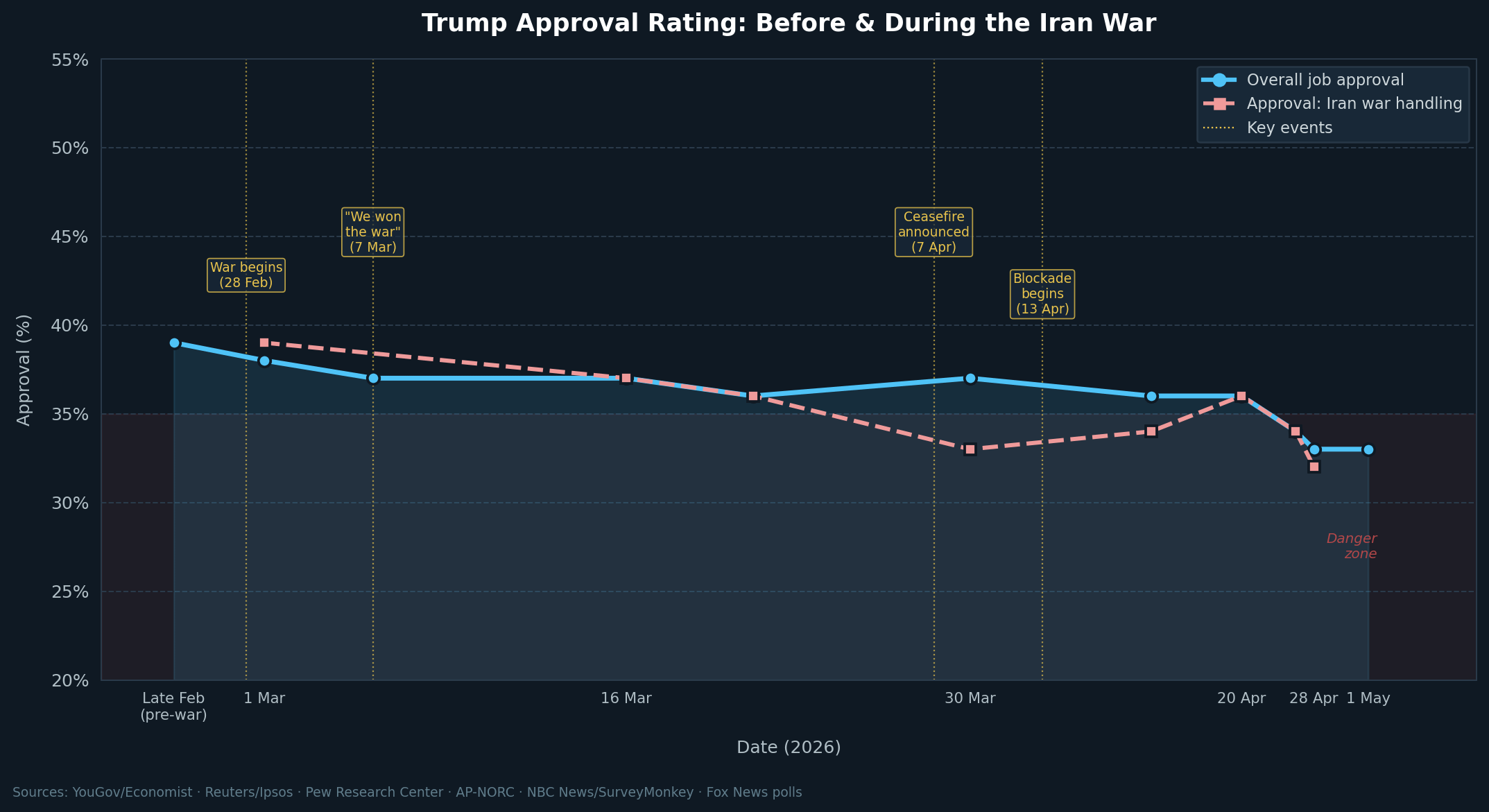
Figure 2. Consolidate poll results regarding President Trump’s approval rating as President (blue line) and his approval in handling the Iran conflict (pink line).
It seems that confusion in the Strait will continue — and perhaps no one knows what the next steps will be, even Trump himself. Whatever the outcome, the economic impact and oil supply disruption will be felt for at least the next 12 months. There is also the deepening fracture within NATO, with Europeans increasingly at odds with President Trump, who has declared he is “no more Mr Nice Guy” in his dealings with allies, let alone the Iranians. Further challenges lie ahead — and it may be time to stock up on toilet paper!
Further challenges lie ahead — and it may be time to stock up on toilet paper!
We live in unpredictable times. Which is precisely why the Sons of Issachar matter. Jesus himself gave the instruction: “Watch and pray.” (Matthew 26:41)
1 Chronicles 12:32 — “And of the children of Issachar, which were men that had understanding of the times, to know what Israel ought to do.”